I’ve Produced Videos for 12 Years. I Want to Kill the Video Production Brief Template.
By Ivan Us, producer and founder of VILKA and Aivus
You need a video.
Maybe your boss asked for a product launch video. Maybe sales needs an explainer. Maybe HR suddenly needs five employee stories by the end of the month.
So you Google “video production brief template,” download a document with 40 questions, open it and immediately think: what the hell am I supposed to put here?
I get it.
Don't want to read? Try to create your AI brief first and then come back.
I’ve produced video projects for more than 12 years. I’ve worked with marketers, agencies, directors, freelancers and production companies across different countries. I’ve made projects for brands including Coca-Cola, Bayer, Bosch, Biocodex and Lactalis.
And after all that, I’m convinced that a blank video brief template is one of the worst ways to start a project.
Not because briefs are useless. A good brief can save the whole production.
The problem is the template.
It gives every project the same questions, even though every video is different. It asks marketers for production answers they may not know yet. Then a producer gets the document, reads it and still has to schedule a call, send three emails and ask the real questions from scratch.
That’s the process I want to get rid of.
The First Video Request Is Usually Messy. That’s Normal.
Most video projects don’t start with a beautiful brief.
They start like this:
We need a short video for our new product. It should feel premium and work on social. We need it next month. Can you send a quote?
Honestly, that’s fine. A marketer shouldn’t need to become a producer before contacting a production company.
The real problem starts when everyone pretends this is enough information for a quote.
What does “short” mean? Fifteen seconds or two minutes?
Does “social” mean one 16:9 video for YouTube, or six vertical cutdowns for paid ads?
Does the idea already exist? Do we need a script? Actors? Locations? Animation? Product shots? Voice-over? Subtitles? Music rights?
And what does “premium” mean here? A controlled studio shoot? A celebrity? Great art direction? Expensive locations? Or just clean lighting and good editing?
Each answer changes the crew, schedule, production approach and budget.
A static video project brief template can collect words. It can’t tell when those words contradict each other.
A producer can.
Why Finding a Video Vendor Feels So Uncomfortable
I think the industry often forgets what this process looks like from the client side.
If you’ve never commissioned a video before, you may not even know who you need.
A freelance editor?
A videographer with a camera and a small kit?
A motion design studio?
A creative agency that develops the idea?
A full production company with a producer, director, crew and post team?
These people can all “make a video,” but they sell completely different services.
The budgets can also be completely different. One project may cost $3,000. Another may cost $30,000. Another may cost $300,000. All three can be reasonable, depending on what you’re actually trying to make.
That makes the first vendor search stressful. You don’t know what the normal process is. You don’t know which questions matter. You don’t know whether the quote includes everything. And sometimes you don’t even know whether two vendors are pricing the same job.
This is exactly where a good production brief should help.
It should translate your business need into something a freelancer, video agency or production company can actually estimate.
Why a Generic Video Brief Template Fails
A downloadable template has no idea what you’re making.
It doesn’t know that a pharma video may need medical and legal review. It doesn’t know that a food shoot may need a food stylist and tabletop crew. It doesn’t know that a founder interview can be captured by a lean three-person team, while a commercial with actors and several locations needs a completely different setup.
So the template usually does one of two things.
It asks too little:
What is the video about?
Who is the audience?
What is the deadline?
Or it asks everything:
Which camera should be used?
What frame rate do you need?
What lighting package do you prefer?
Which codec should the final master use?
Most marketers shouldn’t have to answer those technical questions. That’s the production team’s job.
The client needs to explain the problem, the audience, the message, the intended use, the real constraints and the result they expect.
The producer should turn that into a workable production plan.
That’s why copying a random video production brief example rarely solves the problem. It may look organized, but organized is not the same as useful.
A Brief Is Not a Tech Spec
This gets mixed up constantly.
A brief explains why the video should exist and what it needs to do.
A technical specification explains what needs to be produced and delivered.
For example:
Brief:
Help first-time buyers understand why the product is easier to use than the main alternative.
Target US customers aged 25 to 40.
Build trust and drive people to the product page.
Technical spec:
One 30-second hero video.
Three 15-second cutdowns.
16:9, 1:1 and 9:16 versions.
Captions and clean textless masters.
Licensed music for one year of paid digital use in the US.
The technical spec should come from the brief.
If you start with “we need a 30-second 4K MP4,” you still haven’t explained what the video is supposed to achieve. You’ve described a file, not a project.
Creative Brief vs Production Brief
There is another important split.
A creative brief is for developing the idea. You know the business problem, audience and message, but you still need the concept, script or campaign approach.
A production brief is for making the idea. The concept may already exist, and now the team needs to understand the execution, scope, deliverables, schedule and budget.
Sometimes you need both. Sometimes you only need one.
The mistake is sending a production company a few technical requirements when the project still needs creative development, then expecting a firm production quote.
If the idea isn’t clear, the scope isn’t clear. If the scope isn’t clear, the estimate is mostly assumptions.
What I Actually Need Before I Can Price a Video
I don’t need a client to know every production detail. I need enough information to recommend the right approach.
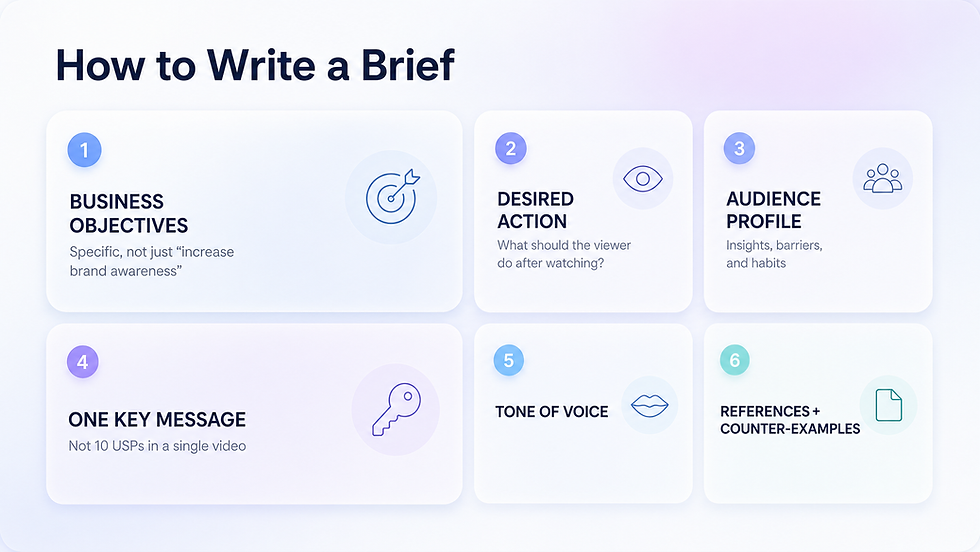
These are the questions that usually matter first:
1. What needs to happen after someone watches?
Do they need to understand the product, trust the company, buy something, sign up, apply for a job or remember the brand?
“We need a video” is not the objective. It’s the output.
2. Who is the real audience?
Not “everyone.” Who specifically needs to care, and what do they already know?
A video for procurement managers should not be built like a TikTok ad for college students.
3. Where will the video run?
Website, YouTube, LinkedIn, paid social, trade show, internal meeting, broadcast or all of them?
Distribution affects runtime, aspect ratios, captions, versions, usage rights and sometimes the entire creative approach.
4. What already exists?
Is there only a rough idea? An approved concept? A script? Storyboards? Brand guidelines? Product assets? Previous footage?
This tells us where the production team needs to start.
5. What must be included?
Claims, product features, logo, CTA, legal copy, speakers, locations, languages and mandatory brand elements.
These details often look small at the beginning and become expensive when they appear late.
6. Who approves the work?
One decision-maker or seven departments?
The number of approval layers can change the schedule more than the shoot itself.
7. What is the actual deadline?
Not just the launch date. We need time for concepting, scripting, pre-production, shooting, editing, feedback, revisions and delivery.
8. What budget range are we working with?
Yes, the budget question can feel uncomfortable. But hiding it doesn’t create a better deal.
It usually creates three proposals for three completely different projects.
Give me the range and I can tell you what is realistic, where the money should go and what we should simplify.
A Better Brief Makes Video Pricing Less Murky
No document can guarantee that a vendor will never overcharge you. Anyone promising that is selling fantasy.
But a clear video production brief makes the pricing much easier to check.
It helps every vendor quote the same scope. It exposes assumptions. It shows whether scripting, casting, locations, crew, equipment, editing, motion graphics, music, usage and delivery versions are included.
Then you can compare actual production approaches instead of staring at three totals that have nothing in common.
The cheapest estimate may be missing half the job. The highest estimate may include a creative team and usage rights that nobody else priced. Without a proper brief, you won’t see the difference until the project is already moving.
That’s how budgets grow: not always because somebody is trying to cheat you, but because important decisions were never made at the start.
So I Built the Tool I Wanted Clients to Have. And it's not a Generic Video Production Brief Template.
After 12 years of asking the same intake questions, I got tired of the whole routine.
Not tired of clients. Tired of the broken process.
The blank template. The giant questionnaire. The hour-long call. The follow-up email. Then another follow-up because one answer created three more questions.
So we built [Aivus](https://aivus.co), an AI project manager trained on the questions, checks and production logic I’ve learned over 12 years of making videos for marketing teams.
You don’t need to know how to write a video production brief.
You can paste the rough request you already have, upload the document your team sent you or simply explain the idea in normal words. Aivus reads it, spots what is missing and asks the questions that matter for your specific project.
Not 40 generic questions. The next useful question.
Then it turns the conversation into a structured, ready-to-send PDF production brief. It also prepares an email you can send to a freelancer, agency, in-house team or production company.
The whole first pass takes about five minutes.
The point is not to make a prettier template. The point is to help you think through the project with an AI producer before vendors start making expensive assumptions.
What Aivus Does Now
Today, Aivus helps you:
Turn a rough idea, messy email or existing document into a structured video brief.
Answer questions in a normal conversation instead of filling out a huge form.
Catch missing information about goals, audience, deliverables, budget, timing and approvals.
Generate a professional PDF brief.
Prepare a clean vendor email.
For marketers, it works like having a producer on your side before you contact the market.
For agencies and production companies, it can work as an AI intake page that helps clients send something more useful than “we need a cool video ASAP.”
Where We’re Taking It Next
The brief is only the first step.
The larger problem is everything that happens around it: finding the right vendors, sending the request, waiting for replies, chasing missing information, comparing bids and making sure the project doesn’t stall.
That is what we’re building toward.
The next version of Aivus is designed to help:
Find the right type of freelancer, studio, agency or production company for the project.
Send the brief to selected vendors.
Follow up when somebody doesn’t reply.
Collect proposals and summarize what each vendor included.
Compare scope, assumptions, timelines and pricing side by side.
Monitor incoming project emails and respond quickly when a new request arrives.
Remember decisions, promised dates and next steps.
In other words, not another AI note-taker. An AI project manager that helps keep the job moving.
These vendor and follow-up tools are the roadmap, not the current free brief demo. I’m saying that clearly because I hate product pages that pretend the whole future already exists.
AI Doesn’t Replace the Producer
I’m a producer. I’m not building software to pretend producers are unnecessary.
AI can structure information, ask follow-up questions and catch obvious gaps. It can remove a lot of repetitive intake work.
It cannot fully judge taste, chemistry, creative risk or whether a specific director is right for a sensitive brand. It doesn’t replace the person responsible for the final call.
But most projects don’t need senior producer time spent copying information between emails and chasing somebody for an aspect ratio.
Let AI handle that part. Let people make the decisions that actually need experience.
Stop Downloading Templates. Start With a Conversation.
If you already know exactly how to write a production brief, use whatever document works for you.
But if this is your first time hiring a videographer, editor, agency or production company, you shouldn’t have to guess your way through an industry you don’t know.
Tell Aivus what you’re trying to make. Upload what you already have. Let it ask the missing questions and turn the mess into a clear PDF brief.
Then send that brief to any vendor you want.
That’s more useful than another video production brief template sitting in your Downloads folder.
FAQ Block
What is a video production brief?
A video production brief explains what the video needs to achieve, who it is for, where it will run, what needs to be delivered and which budget, schedule and brand constraints matter. It gives a production team enough information to recommend an approach and prepare an estimate.
What should a video production brief include?
It should include the objective, audience, key message, CTA, channels, deliverables, runtime, creative status, mandatory elements, available assets, approval process, deadline and budget range.
What is the difference between a creative brief and a production brief?
A creative brief helps a team develop the idea and message. A production brief helps a team execute an approved or partly developed idea by defining scope, deliverables, schedule, budget and production requirements.
Can AI write a video production brief?
Yes. An AI producer can analyze a rough request, ask for missing information and organize the answers into a usable brief. A human should still review the final document and make important creative, budget and vendor decisions.
Why is an AI producer better than a video brief template?
A static template asks the same questions for every project. An AI producer can adapt the next question to the project, identify contradictions and skip technical questions the client should not need to answer.
How long does it take to create a brief with Aivus?
Most users can create a first PDF video production brief in about five minutes, depending on how much information they already have and how complex the project is.

Comments